

During its Jan. 22 meeting, the Board of Trustees agenda included:
- Spotlight on Learning: Westside ES
- 2026–27 Academic Calendar Recommendation Shaped by Community Feedback
- Board Approves Budget Assumptions to Guide Early Planning for 2026–27
- Bond Updates: Turf Safety Improvements at Stadiums; Faubion Facility Planning
- Board Approves Interim Legislative Priorities Informed by Community Listening
- Instructional Materials Adoption Update
The Board will meet next for a regular meeting Thursday, Feb. 5.
Spotlight on Learning: Westside ES
Students and teachers from Westside Elementary shared how collaborative learning is helping them take greater ownership of their thinking and problem-solving.
Fifth-grade students highlighted their experience with Building Thinking Classrooms, where working in teams, sharing ideas and learning from mistakes strengthens understanding and builds confidence. Students also showed leadership beyond the classroom by securing PTA grants to expand whiteboards in math classes, advocating for tools that support collaboration and learning.
Through teamwork, creativity and persistence, Westside Rockets are building skills that extend far beyond math class.
Go Rockets!
2026–27 Academic Calendar Recommendation Shaped by Community Feedback
🎬 7.A.1. Discussion of 2026-2027 and 2027-2028 Academic Calendars
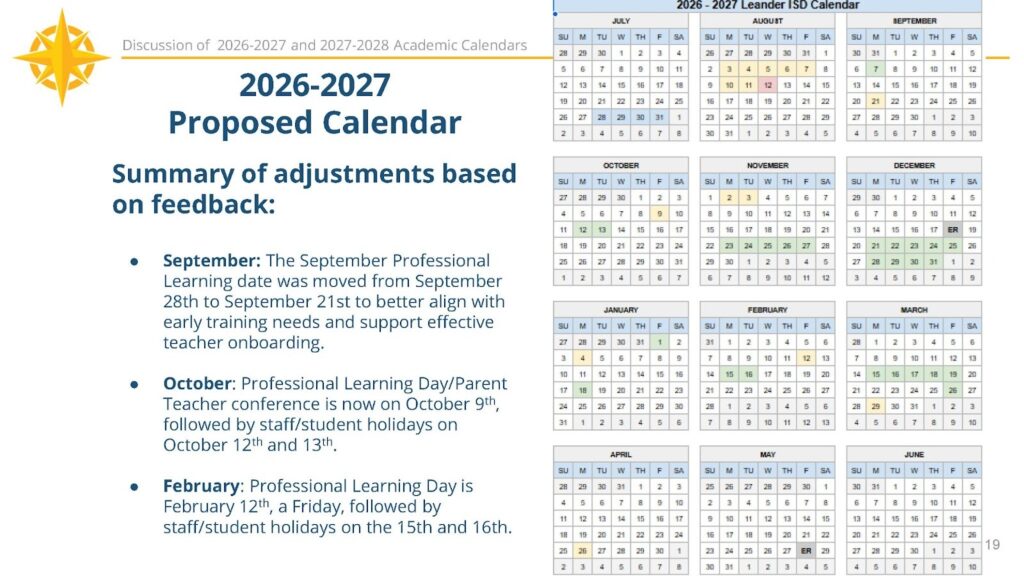
Trustees reviewed proposed academic calendars for the 2026–27 and 2027–28 school years, focusing on how community feedback and statutory requirements informed the recommended designs.
For 2026–27, the recommended calendar reflects input from nearly 5,000 students, families and staff, and it continues patterns that received strong support in recent years.
Key highlights of the proposed 2026–27 calendar include:
- First day of school: Wednesday, Aug. 12, 2026
- Last day of school: Friday, May 28, 2027, ending before Memorial Day
- Student and staff breaks: Continued inclusion of a full week for Fall Break and two weeks for Winter Break, and one week for Spring Break, all of which were identified as highly valued for rest, morale and work-life balance
- Refined mid-semester break structure: The recommended calendar makes a minor change to the breaks in October and February introduced in this current 2025-2026 school year, flipping the professional learning day to Friday and moving the student & staff days off to Monday and Tuesday in response to community feedback.
Trustees also previewed a draft 2027–28 calendar, noting that while no changes are recommended at this time, the district will continue monitoring factors such as election day impacts on campuses before final adoption.
The Board is projected to take action on the 2026–27 academic calendar at the Feb. 19 meeting.
Previous Updates
- Nov. 6, 2025: Board Reviews Early Draft of 2026–2027 Academic Calendar
- Oct. 13, 2025: Help Shape the 2026-27 Academic Calendar
Board Approves Budget Assumptions to Guide Early Planning for 2026–27
🎬 7.C.4. Discussion and Consider Approval of the 2026-2027 Budget Assumptions
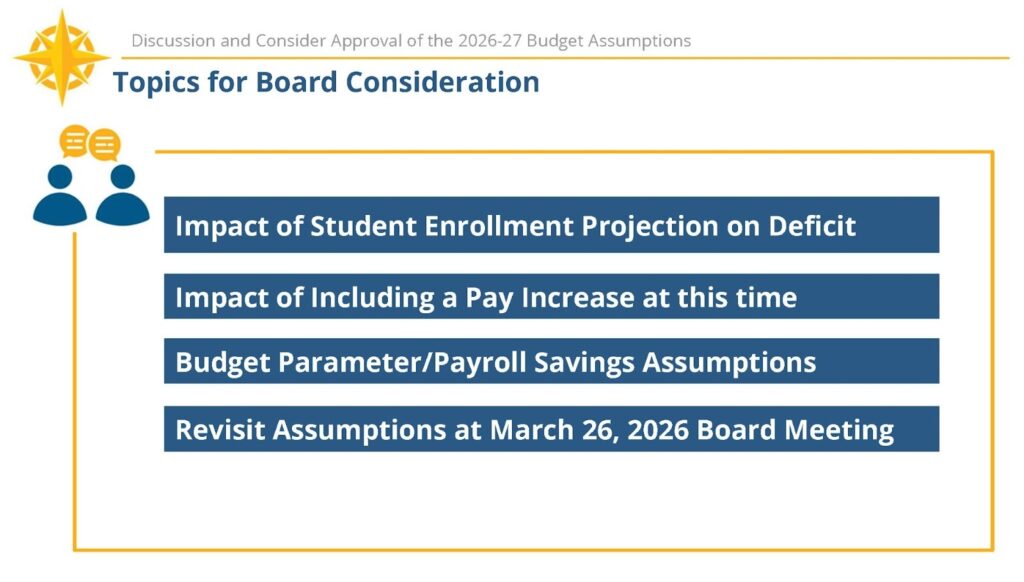
Trustees approved a set of budget assumptions to guide development of the 2026–27 budget, providing a starting point for planning while acknowledging that key decisions will be revisited as more information becomes available.
To date, the district has identified nearly $7 million in reductions toward an estimated $12.7 million deficit above the 1.5% budget parameter. This follows the significant cuts implemented in this 2025-26 school year of approximately $15 million.
As the current year unfolds, early financial “actuals” show optimism of revenues coming in higher than initially projected. Trustees noted this could lead to future discussion about whether certain assumptions for 2026-27 — the 1.5% parameter or budgeting payroll at 98% — could be adjusted as clearer data becomes available.
Key assumptions approved at this stage include:
- Student enrollment of 41,841, based on the projected model in the latest demographic update, down from the prior year.
- Average daily attendance rate of 94.125%, a slight increase from the previous year.
- Property value growth based on 3%, a more conservative assumption than the 4% used in 2025–26.
- $1 million budgeted for the next phase of implementation of last year’s Texas Association of School Boards (TASB) pay study adjustments. No additional employee pay increase included at this time, with the understanding that compensation will be revisited as the budget becomes more defined.
- Funds included to open the Early Childhood Center in 2026–27, consistent with prior planning.
District leaders emphasized that these assumptions are not final decisions, but planning tools that allow the Board to evaluate options responsibly while protecting student learning and supporting staff.
Another budget workshop is planned for March 26.
Previous Updates
- Jan. 8, 2025: Board Workshop Focuses on 2026–27 Budget Development
- Dec. 17, 2025: Board Approves Faubion Elementary Consolidation; Sets Direction for Continued Long-Range Planning
- Dec. 11, 2025: Enrollment Thresholds Approved, Projecting $2M in Savings; School Consolidation Vote Set for Dec. 17
- Oct. 30, 2025: Budget Development Update Factors Recent Demographic Update & Previews Detailed Cost Report
- Sept. 30, 2025: Board Adopts Resolution to Guide LISD Administration Through Next Steps
- Sept. 18, 2025: No School Consolidation Decisions Made; Board Sets Sept. 30 Special Meeting to Establish Clear Next Steps
- Sept. 10, 2025: Leander ISD Trustees Confront Budget Realities While Charting a Path Forward
Bond Updates: Turf Safety Improvements at Stadiums; Faubion Facility Planning
🎬 7.C.1. Consider Approval of Bond Oversight Committee Recommendation to Reallocate Bond Funds for the Replacement of Artificial Turf at AC Bible and Monroe Regional Stadiums
🎬 7.C.2. Discussion and Consider Approval of Pfluger Architects for Architectural Design Services Related to the Repurposing of Faubion Elementary School
Bond Oversight Committee Recommendation Approved for Replacement Stadium Turf
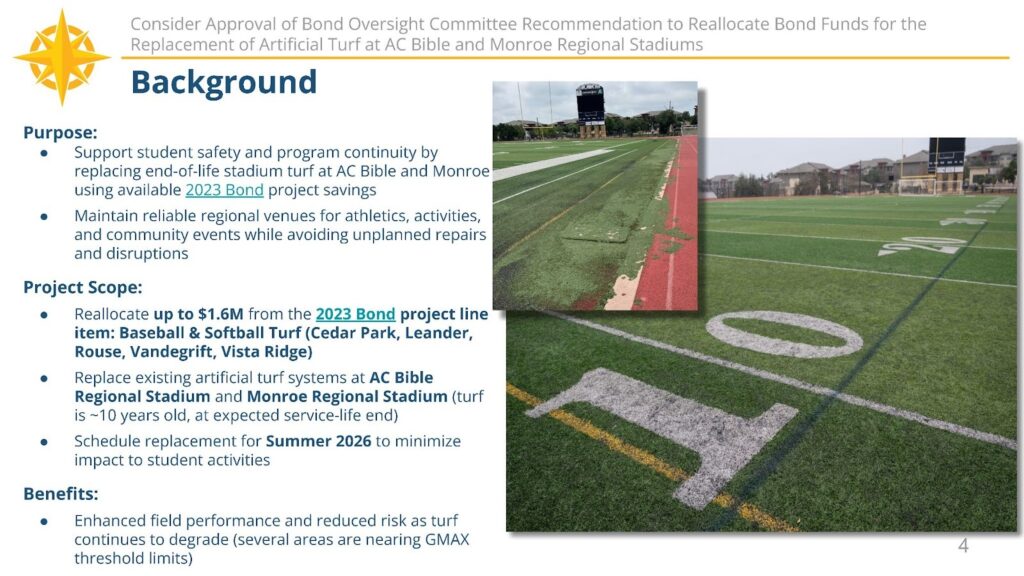
The Board approved a recommendation from the Bond Oversight Committee (BOC) to reallocate bond funds to support the replacement of artificial turf at Bible Stadium and Monroe Stadium.
The BOC met earlier in January and unanimously supported bringing this recommendation forward after reviewing the condition and remaining lifespan of the existing turf, which has reached the end of its usable life and presents growing safety concerns for student-athletes. Replacing the turf this summer will help maintain safe playing conditions, avoid disruptions to athletic seasons, and reduce the risk of unexpected field closures.
Project savings within the 2023 Bond baseball and softball turf projects at the high schools exceed the $1.6 million needed for this turf work at the stadiums, allowing the reallocation to not impact the completion of the original bond projects.
ℹ️ Bond Oversight Committee’s process & membership
Architect Approved for Faubion Elementary Repurposing Work
Trustees also approved the selection of an architect to begin design and planning work associated with the future repurposing of the Faubion Elementary campus. This step allows the district to move forward with early programming and design exploration tied to long-range planning priorities, following the Board’s decision to consolidate Faubion Elementary after the 2025–26 school year.
Any future repurposing of the Faubion facility will be funded through the voter-approved 2023 Bond. Additional details about potential uses and timelines will be developed through the design process and shared with the community as planning continues.
Board Approves Interim Legislative Priorities Informed by Community Listening
Trustees approved Leander ISD’s interim legislative priorities, informed by feedback gathered through the district’s second round of Legislative Listening Circles.
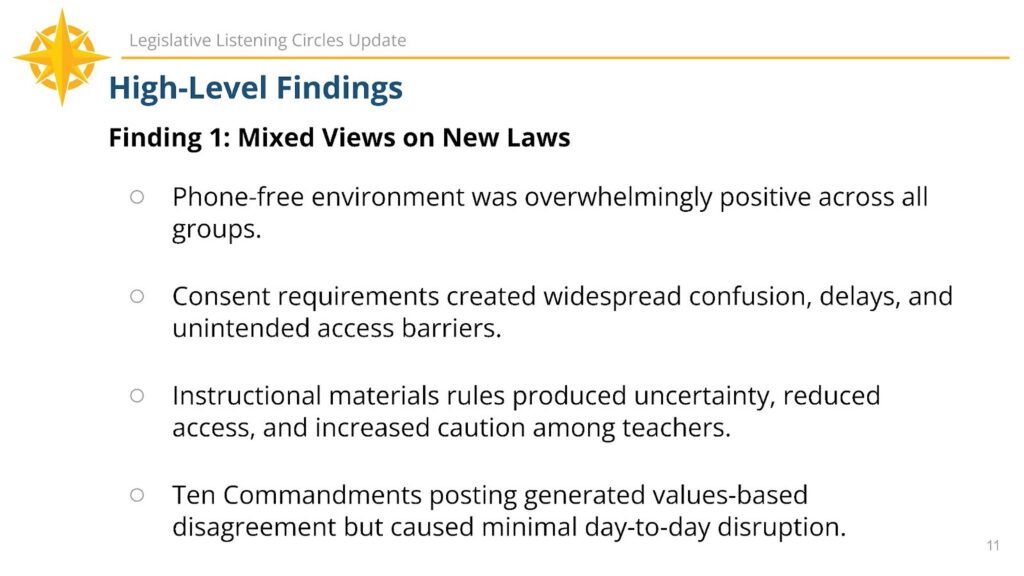
This round of listening circles focused on understanding how recently passed state laws are impacting students, staff and families in real time. Nearly 500 participants — primarily staff — took part in in-person discussions designed to capture lived experiences during implementation, including what is working well and where strain or unintended challenges are emerging.
Based on that feedback, Trustees discussed and approved interim priorities to guide advocacy efforts ahead of the next legislative session. These priorities are intended to help lawmakers better understand the practical impacts of policy decisions on classrooms, campuses and district operations.
Key themes reflected in the interim priorities include:
- Implementation clarity and local flexibility, particularly around consent requirements, instructional materials and operational timelines
- Support for educators and staff, including concerns related to compensation, workload and retention
- Special education funding and evaluation processes, building on continued advocacy from the prior session
- Student experience and access, ensuring new laws do not unintentionally limit participation in learning opportunities or extracurricular activities
Trustees emphasized that the interim priorities are not a replacement for the Board’s previously adopted legislative priorities, but rather a focused set of guiding issues based on current community feedback. The district will continue engaging with legislators and education partners to advocate for solutions that reflect the needs of Leander ISD students, staff and families.
Instructional Materials Adoption Update
🎬 7.A.3. Discussion of Instructional Materials Adoption Process Update
Trustees received an update on the instructional materials adoption process for courses planned for implementation in the 2026–27 school year, with a focus on early literacy and math.
K–3 phonics: The district is evaluating state-approved phonics resources, with an emphasis on alignment to Texas standards, strong literacy practices, and availability in both English and Spanish. Feedback from campus leaders supported moving forward with a new phonics resource.
Elementary and secondary math: Planning is underway for future math adoptions, with careful consideration of implementation timelines, upcoming state math academies, and minimizing instructional overload for teachers.
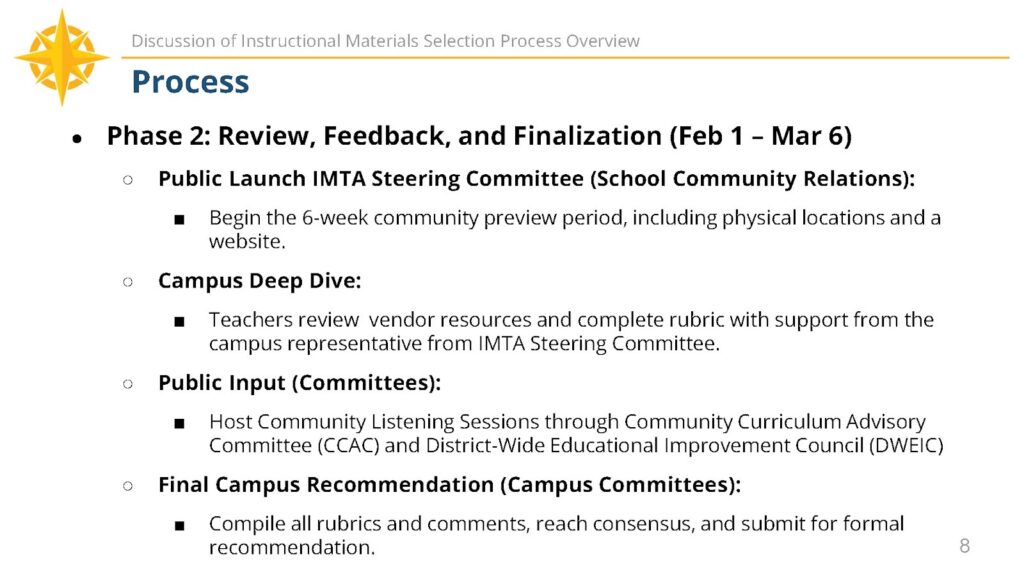
Phased, collaborative process: Staff outlined a multi-phase approach that includes educator involvement, community review opportunities and Board action before any final selections are made.
District leaders emphasized that pacing, professional learning and implementation support are central to the process to ensure new materials strengthen instruction without overwhelming campuses. A formal community review and feedback window will begin in February, ahead of any final recommendations that are brought to the Board.
