

During its Sept. 17 meeting, the Board of Trustees agenda included:
- Efficiency Audit Reviews District Spending Ahead of Proposition A
- Spotlight on Operations: PLCs Beyond the Classroom
- Operational Department Plans Connect Work to Student Experience
The Board will meet next for a meeting Thursday, Oct. 1, 2026.
Efficiency Audit Reviews District Spending Ahead of Proposition A
🎬 9.C.1. Discussion of Efficiency Audit in Conjunction with Voter-Approval Tax Rate Election (VATRE)
As part of the requirements associated with Proposition A, Trustees reviewed an independent efficiency audit conducted by Whitley Penn examining Leander ISD’s fiscal management, efficiency and use of resources.
The audit follows established state guidelines and uses the most recently available statewide data — primarily from the 2024–25 school year — to compare Leander ISD with eight peer districts and statewide averages. Since that reporting period, LISD has implemented approximately $26 million in budget reductions over two budget cycles, meaning some current staffing and spending levels have changed from those reflected in the audit.
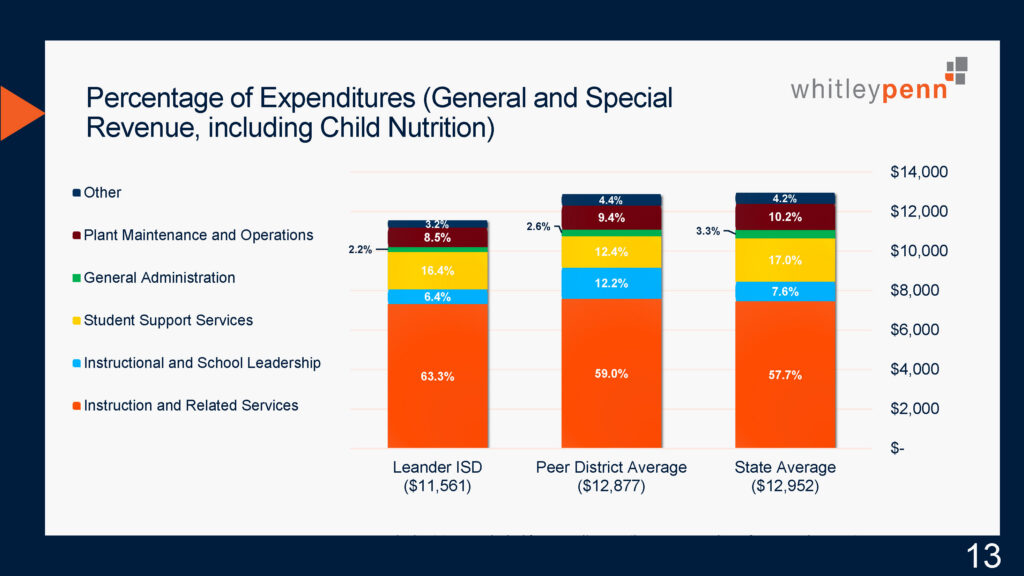
Among the findings, Leander ISD spent $11,561 per student, compared with $12,877 among peer districts and $12,952 statewide. The report also showed differences in how those dollars were allocated:
- 63.3% of LISD expenditures went toward instruction and related services, compared with 59% among peer districts and 57.7% statewide.
- 2.2% went toward general administration, compared with 2.6% among peer districts and 3.3% statewide.
Leander ISD also earned an A, or Superior rating, in the 2025 School Financial Integrity Rating System of Texas (FIRST), the state’s financial accountability system for public schools.
Trustees discussed how the findings fit into the district’s broader financial picture, including staffing levels, teacher compensation, fund balance and continued efforts to increase revenue and manage expenses. District leaders emphasized that Proposition A represents one component of that broader financial strategy rather than a standalone solution.
For the full efficiency audit and additional information about Proposition A, visit elections.leanderisd.org.
Spotlight on Operations: PLCs Beyond the Classroom
🎬 3.A. Spotlight on Operations: Professional Learning Communities
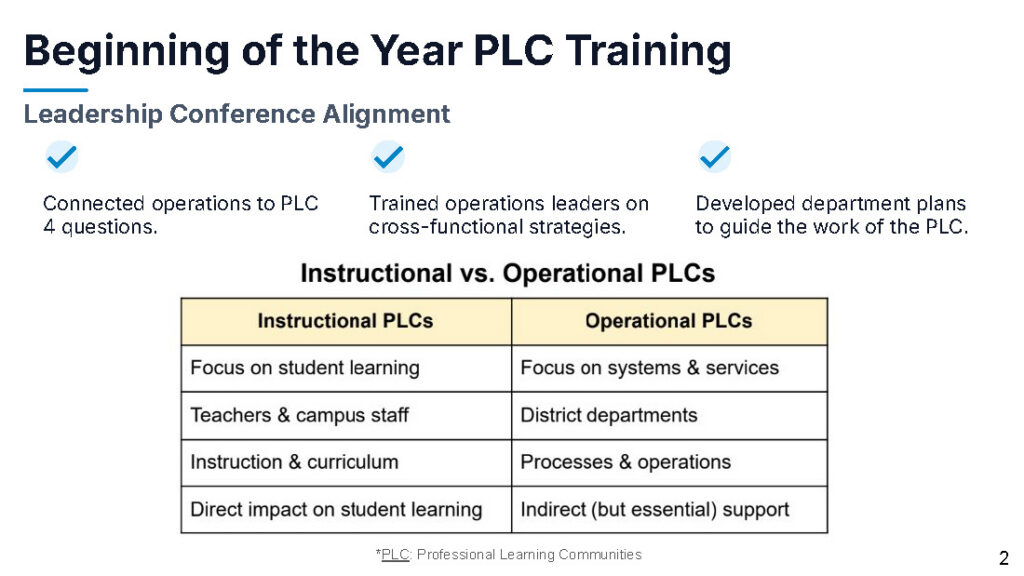
Professional Learning Communities (PLCs) are often associated with teachers and classroom instruction, but Leander ISD highlighted how the same continuous-improvement approach is being used across operational departments.
While instructional PLCs focus directly on student learning, operational PLCs focus on the systems, processes and services that support campuses and help remove barriers for students and staff. Operations leaders regularly work within their own departments and across teams to identify challenges, share ideas and improve how the district supports schools.
The Spotlight featured examples from Facilities & Operations and Human Resources. Facilities & Operations uses regular team meetings and leadership sessions to strengthen collaboration and problem-solving. In another example, HR works both internally and cross-collaboratively with Technology and Finance and also partners with HR leaders from other school districts to share resources and address common challenges.
This fits within the broader goal of building a culture of continuous learning and collaboration from the boardroom to the classroom.
Operational Department Plans Connect Work to Student Experience
🎬 9.A.1. Discussion of Board Goal Report – Guardrail 5 (Department Plans)
Building on the Spotlight on Operations, Trustees received their first Board Goal Report connected to Guardrail 5: Effective & Efficient Operations, which calls for non-instructional departments to establish performance indicators aligned with district priorities.
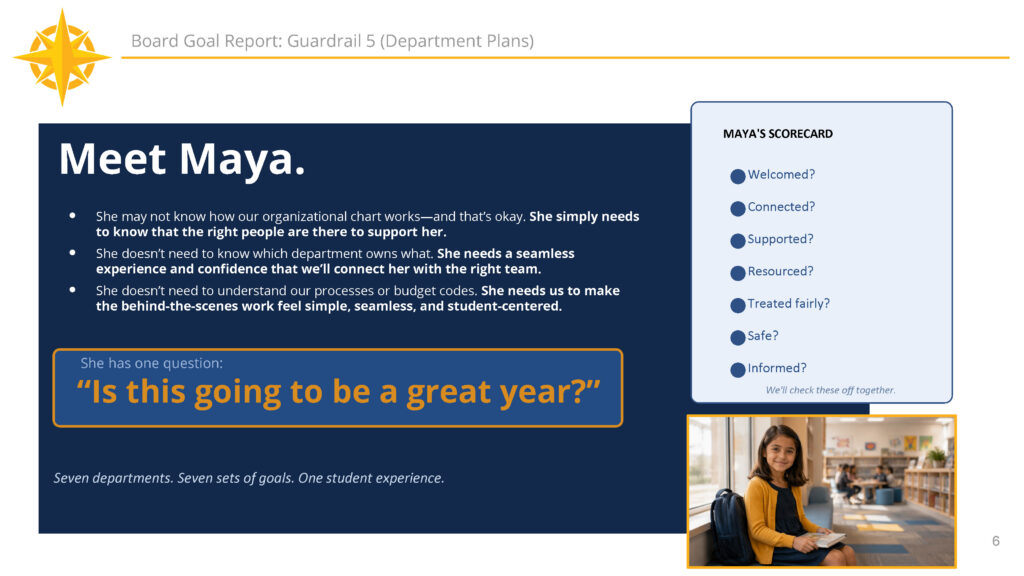
The 2026–27 department plans include strategic goals, specific measures and progress-monitoring expectations designed to connect behind-the-scenes operational work to the student experience. District leaders framed that connection through “Maya,” a representative student who may never know which department is responsible for a particular service; she simply experiences one school.
Leaders from Facilities & Operations, Technology, Human Resources, Finance, Legal Services, the Leander ISD Police Department and School & Community Relations shared examples ranging from improving transportation reliability and cybersecurity to strengthening hiring practices, financial transparency, student safety and communication.
Trustees focused much of their discussion on how the Board should monitor that work over time. They emphasized the need for clear measures and shared definitions of success that allow them to understand whether departments are on track without moving into day-to-day operational management.
District leaders noted that each department already has a more detailed written plan with goals, strategies, measurements and progress-monitoring components, while acknowledging that the broader Board monitoring process is still being developed. Trustees and administration expect to continue refining that approach as they move through the first full cycle of the new goals and guardrails.
